The Growth Gap: Why 40% of Private Schools Grow and Yours Doesn't
The short answer
Growing schools aren't winning because families suddenly discovered private education. They built a funnel that captures demand already searching, mostly by fixing what happens between inquiry and tour. Flat enrollment in a rising market is a capture problem in disguise.
On this page⌄
If 40% of private K-12 schools are growing and yours isn't, the market is almost certainly not your problem. Growing schools aren't winning because families suddenly discovered private education. They're winning because they built a funnel that captures demand that's already searching, and the demand accrues to whoever captures it, not to whoever deserves it.
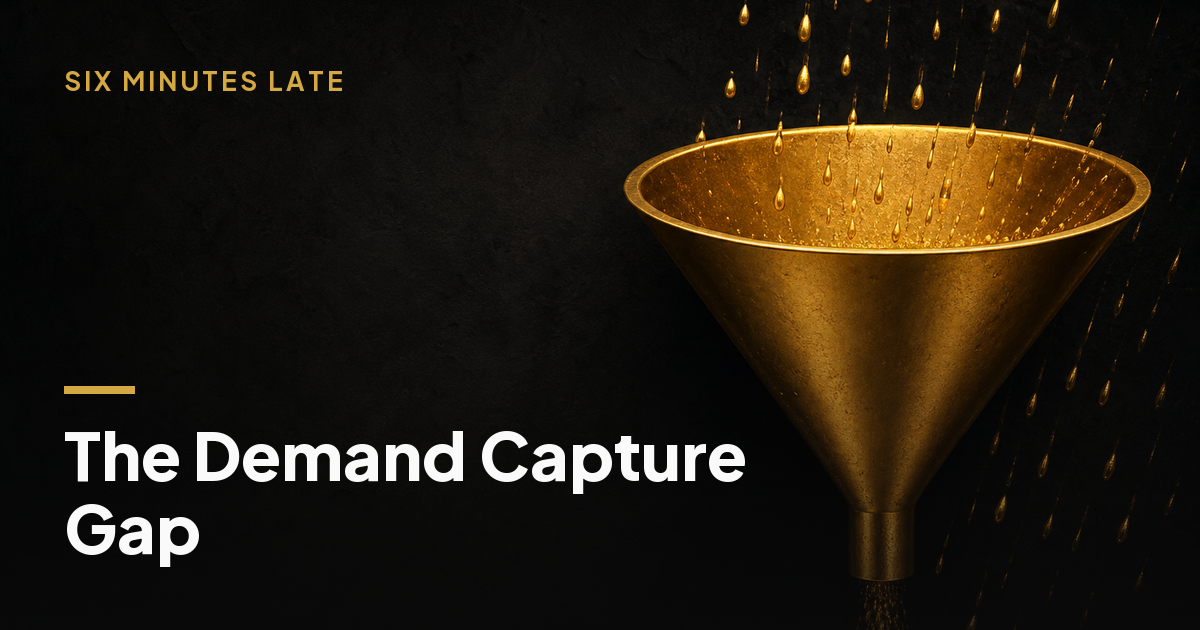
Here's the reframe: the macro tailwind is real, but it doesn't distribute evenly. A rising market lifts the schools with tight capture and leaves the rest wondering why the wave never reached them. When you feel like you're recruiting against the tide in a year the tide is supposedly with you, that gap has a name. I call it the Demand Capture Gap: the distance between the interest already pointed at your school and the interest you actually convert into enrolled families.
The good news is that a capture problem is fixable, and it's cheaper to fix than a demand problem. You don't need more families to know you exist. You need to stop leaking the ones who already do.
Is our flat enrollment a demand problem or a capture problem?
Start with the math before you touch the messaging. Pull two numbers: inquiry-to-tour rate and tour-to-enroll rate. Then compare them to reasonable benchmarks for private K-12 admissions. Among independent schools, the acceptance-to-enrollment (yield) rate averages 71.4%, meaning most accepted families go on to enroll, according to NAIS Facts at a Glance, 2024-2025.
The diagnosis is simple:
- Inquiries are absent. Nobody's filling out the form, calling, or requesting info. That's a demand or visibility problem.
- Inquiries come in but stall. Leads arrive, then evaporate before a tour or after one. That's a capture problem, and it's the far more common one.
Most schools that feel stuck have plenty of inquiries. They just lose them in the handoffs: the form that goes to an inbox nobody checks on weekends, the callback that takes four days, the tour that happens but gets no follow-up. If that sounds familiar, you're not fighting the market. You're fighting your own process. Our breakdown of how to fix a leaky enrollment funnel walks through where the leaks usually hide.
The core principle
Why does word-of-mouth stop working the moment the market shifts in your favor?
Word-of-mouth works beautifully in a stable market because the families referring you and the families receiving the referral share context. They know your reputation, they trust the source, the decision is warm.
When the broader market shifts (more families suddenly considering private school for the first time, often reacting to public-school instability), that shared context breaks. The new wave of shoppers doesn't have a friend at your school. They're strangers to your reputation. They start where every stranger starts now: a search bar.
So the exact moment demand surges is the exact moment word-of-mouth covers a smaller share of it. Schools that leaned entirely on referrals feel the ground shift under them precisely when things are supposed to be good. The referral engine didn't break. The market just grew past it, and the growth is coming from people who've never heard your name.
What do growing schools do between inquiry and tour that stagnant schools skip?
This is the whole game. The window between inquiry and tour is the single highest-leverage stage in the funnel, and it's the one thin admissions teams skip most.
Here's what the growers do differently:
- They respond fast. Not same-week. Same-hour where possible. A family that inquired at 9pm on a Sunday has contacted other schools too, and the first specific, human reply wins disproportionate attention.
- They respond specifically. Not "Thanks for your interest, here's a brochure." A reply that names the grade the child is entering, references the family's stated reason for looking, and proposes a concrete next step.
- They qualify for fit early. Growing schools aren't trying to tour everyone. They surface fit signals fast so the tour is with families likely to enroll, which protects a small team's time.
- They stay visible where families are already looking. That means showing up on Google and, increasingly, inside AI chat answers when a parent asks "best schools near me for X."
Stagnant schools treat the inquiry as the finish line. Growing schools treat it as the starting gun. The conversion math behind enrollment makes the stakes obvious: shaving your inquiry-to-tour drop-off by a few points does more for enrolled numbers than doubling ad spend.
Hours, not days
the follow-up speed that separates schools capturing demand from schools losing it
SML enrollment playbook
How do families actually shop for schools now, and where does your funnel lose them?
The modern school search doesn't start with a tour request. It starts with a query. A parent types a question into Google or asks an AI assistant, gets a shortlist, and contacts a handful of schools before they'll set foot on a campus. About 93% of families who go online to find a new school begin their search within a search engine like Google, Yahoo, or Bing Finalsite, 2022.
Your funnel loses families at three predictable points:
- Discovery. You don't appear when they search, so you're never on the shortlist. Being invisible to AI answer engines is the new version of not being on page one.
- First contact. You appear, they inquire, and your response is slow or generic. They mentally cross you off while waiting.
- Post-tour. They visit, like it, and hear nothing for a week. Momentum dies in the silence.
Each of these is a capture failure, not a demand failure. Fixing them is why open houses convert far better when they're wired into a follow-up system instead of treated as a one-day event, which is the point of building an open house that feeds an AI-driven funnel.
How do I turn the tailwind into open-house messaging that converts fence-sitters?
Don't sell "excellence." Every school says excellence. Fence-sitting families aren't stalled because they doubt you're good. They're stalled because they haven't found a reason to decide now.
Translate the macro trend into a family-facing reason to act, tied to your specific fit signals:
- Name the real thing families are feeling (uncertainty about their current school, larger class sizes, a program that got cut).
- Connect it to one concrete thing your school does differently, with a specific detail, not a slogan.
- Give a real deadline that matters (application windows, financial aid cutoffs, limited spots in a grade).
That's the difference between "Join our community of excellence" and "We hold 14 spots in our incoming 6th grade and applications for aid close March 1." One is wallpaper. The other moves a fence-sitter.
The takeaway
Before you approve another ad budget, pull your inquiry-to-tour and tour-to-enroll numbers. If families are inquiring and stalling, you have a capture gap, and more ad spend just makes your leak more expensive. Close the window between inquiry and tour first: respond in hours, respond specifically, follow up after every tour, and make sure you show up where families now start their search. The tailwind is real. Whether it reaches your school depends entirely on whether your funnel holds water.
Want to know if your flat numbers are a demand problem or a capture problem? Book a discovery call and we'll run your funnel math with you.
Want this mapped to your school's enrollment funnel?
We'll spend 20 minutes on your funnel — where inquiries come in, where they stall, and the one or two fixes that move enrollment. It's a working session, not a sales call.
Book a discovery callFrequently asked questions
- If the market is growing, why is our enrollment flat?
- Because growth goes to schools that capture existing demand, not schools that wait for it. Flat numbers in a rising market almost always signal a leak between inquiry and enrolled, not weak demand. The families are searching; your funnel is losing them.
- What are growing schools doing differently in their admissions funnel?
- They treat the window between inquiry and tour as the highest-leverage stage. That means fast, specific, fit-based follow-up plus visibility where families first look (Google and AI chat), not more top-of-funnel ad spend.
- How do I know if my problem is demand or capture?
- Run your inquiry-to-tour and tour-to-enroll rates against benchmarks. If leads come in but stall, it's capture. Only if inquiries themselves are missing is it a demand problem.
- How do I use the macro trend in open-house messaging without sounding generic?
- Translate the tailwind into a family-facing reason to act now, tied to your specific fit signals. Reference real instability families feel, not vague 'excellence' language, and connect it to what your school concretely does differently.
- Should we spend more on ads to catch the wave?
- Not until the funnel holds water. More leads into a leaky capture process just raises your cost per enrolled student. Fix conversion first, then scale spend.
Clint Townsend
Founder of Six Minutes Late. We build enrollment-marketing systems for schools — independent, Montessori, faith-based, and language programs — turning inquiries into enrolled families with faster follow-up and tighter funnels.
Work with us →Get the next one in your inbox
Practical, no-fluff plays on filling seats and building enrollment demand — a couple of times a month. Built for people who actually run schools and programs.